
Senpai Jamie Holmes (2nd Dan)
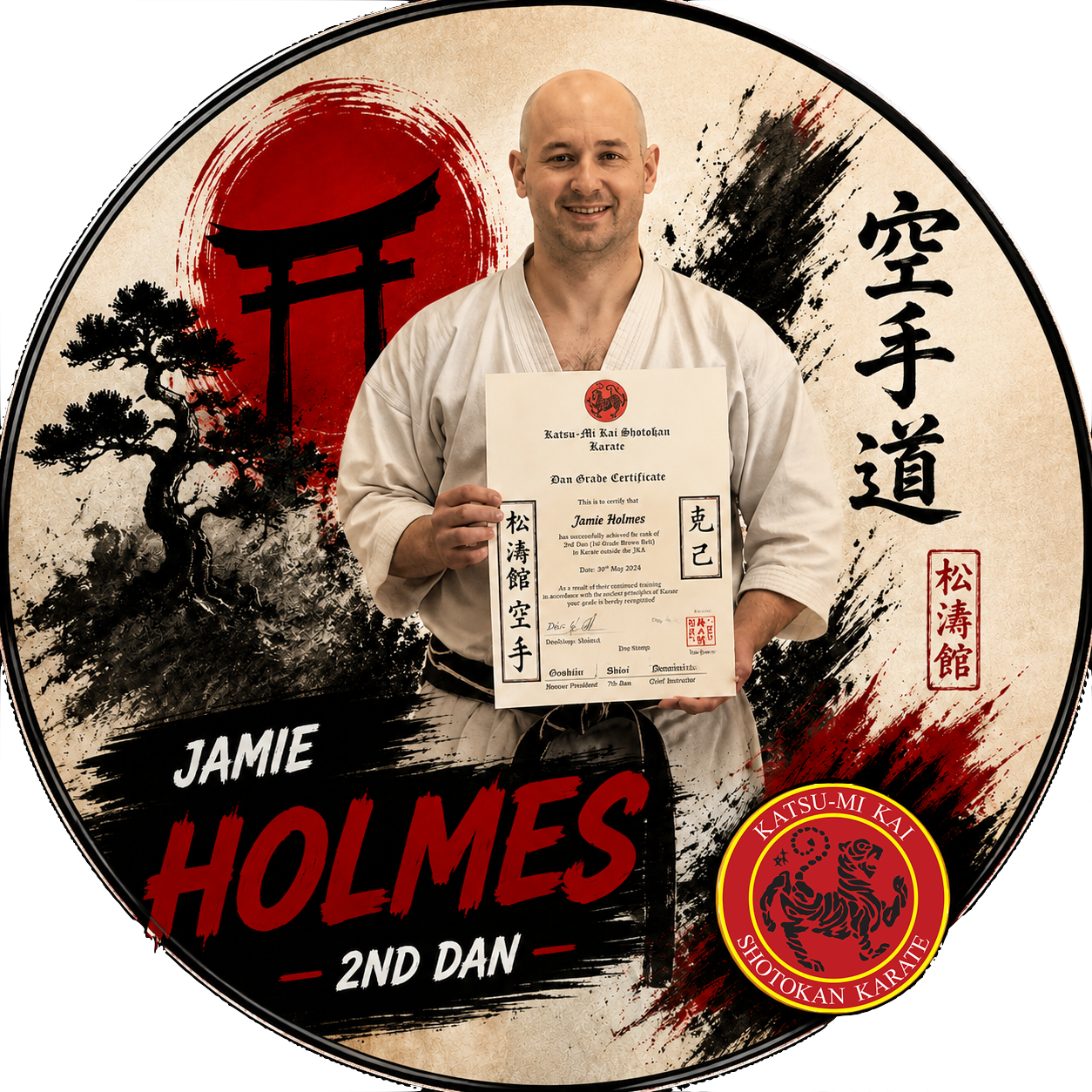
I started karate when I was 6 - studying Goju Ryu. It instantly captivated me. In particular, I always loved kata. The precise nature of the individual forms and body positions, as well as the technical skill involved to make every last technique powerful and accurate, meant there was always something to work on.
I started with Sensei Mark and Shotokan when I was about 10 and graded up through the Kyu grades - making it my mission to learn all the katas as a junior grade is often fond of doing. I wasn't concerned about form (a Zenkutsu dachi oi zuki punch was the same whether it was done in Gojushiho Sho or Heian Shodan - right?) but more about remembering the sequence.
Sensei Mark's approach was very different, however. I remember vividly the first time (when I was about 12 - over 24 years ago now!) learning the hand sequence in Heian Godan being described as a strangle escape and precisely why the hands needed to be in the positions I had been taught. It suddenly started to make so much sense. The wrist grab HAPV in Heian Sandan was also an incredibly early lesson in why the movements were as they were - and the learning of the katas became a search for what things COULD meaningfully represent rather than just being told, as I had so often in Goju Ryu, "because it just is that way".
Sensei Mark's approach to kata was about "telling the story of a fight". He taught us that in his view, the kata was the "nice joined up handwriting you tell your friends afterwards" but that it was important to appreciate where the moves came from in that specific situation for that individual. This is where the personalisation of kata started to make so much sense - and the Heian katas being "training" katas fell into place like a big karate knowledge jigsaw. It was so obvious once you started to look into it how Heian Godan's starting sequence wasn't just inspired by Heian Sandan - it was a "Part 2: What if it fails?". The more we learned, the more it became painfully obvious that these "beginner" katas were hefty textbooks, and I had barely gotten past the contents page. Suddenly 1 kata 3 years didn't seem like a chore - it seemed and underestimation!
Learning the HAPV for specific katas made them relevant and meaningful in a way that I hadn't had from any other instructors. Nobody else was doing this, and it changed the way we trained by giving us guidelines and routines that allowed for maximum effort and "on the limit" contact, without feeling like a script in a fight scene - because instead of a "no...now you punch...then I...no reset..." it was "well I can punch you here - so what does the kata tell you to do as a failsafe if I do that?".
Nijushiho was always one of my favourite katas to perform. I won a gold medal with it at a National Championships, and I foolishly thought I "knew" it. Being able to work on it from a bunkai perspective allowed me to put into practise all of the training I had done in my 30 odd years of karate. The framework of Sensei Mark's Levels of kata bunkai allowed me to explore how this kata could work for me - I was able to use the techniques to explain how someone taller than me (I am not tall myself!) would be vulnerable to the techniques used. I also thought about the situation - why would I use these HAPV reactions rather than the ones I had been taught from the Heian katas - ultimately realising that this could be a fight in dim light conditions making it harder to see.
The process took months and without realising it, embodied all other aspects that karate is, and should be, about. I had to find multiple training partners, talk them through my thoughts and allow them to tell me theirs as to what would and wouldn't work. It required time spent working on other katas to see how I could incorporate elements of them into Nijushiho, including the important failsafes. It forced me to engage with the pure kata theory - elements of the kata that required specific positioning - and working out why that could be the case in a meaningful, reliable and real-world setting manner. When I finished, it felt like presenting a PhD thesis - which is how it should be.