
PAST EVENTS
Seniors Grading – October 2026
Congratulations to everyone who took part in the Katsu-Mi Kai senior grading in October 2026! 🥋
It was fantastic to see the dedication, effort and commitment shown by everyone throughout the grading. Your hard work and continued development are what make our karate community so special.
A particular highlight was the Bunkai, which received unanimous praise from the Senseis. They were all in agreement about just how good the Bunkai was, demonstrating an excellent understanding of the practical applications of Kata and the skill involved in bringing those techniques to life.
Bunkai is about more than simply performing movements. It requires understanding, timing, control and the ability to apply techniques with purpose. Seeing everyone demonstrate this so well was a real credit to the work put in during training.
A huge thank you to all the Senseis for their guidance, support and commitment to helping our students progress, and well done to everyone who took part!
📸 Relive the Day!
Head over to our Senior Grading October 2026 Photo Gallery to see highlights from the day and celebrate the achievements of our members.
👉 Click here to view the Senior Grading October 2026 Photo Gallery
Focus • Discipline • Respect • Improvement
Katsu-Mi Kai Shotokan Karate
To overcome your weaknesses.
🏆 Legends Open Competition 2026
Surrey Sports Park, Guildford | March 2026
Katsu-Mi Kai was proud to take part in the Legends Open Competition 2026, held at Surrey Sports Park in Guildford.
It was a fantastic opportunity for our members to represent Katsu-Mi Kai, put their training into practice and experience the excitement and challenge of competition.
Most importantly, the day was about supporting one another, showing respect and demonstrating the spirit of Katsu-Mi Kai both on and off the competition floor.
Watch the highlights below and see Katsu-Mi Kai in action at the Legends Open 2026. 🥋🏆
Kata & Bunkai Course – A Fantastic Day of Training
What a fantastic day of karate!
Our Kata & Bunkai Course in Westbury brought together karateka for a full day of training, learning, discussion and practical exploration.
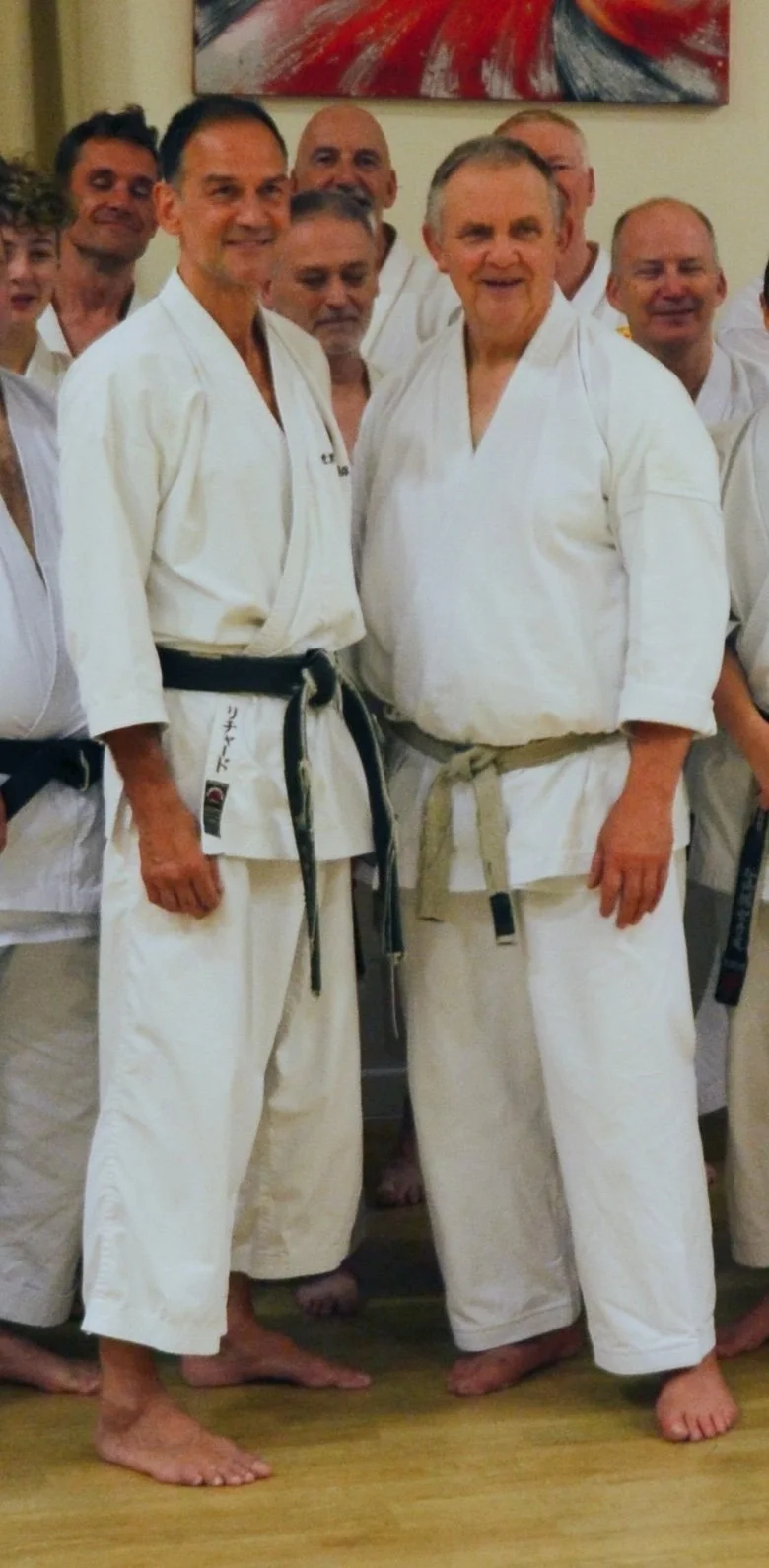
A huge thank you to Sensei Carroll, 7th Dan, and Sensei Richard Amos, 8th Dan, for sharing their knowledge, experience and different approaches throughout the day.
The course gave everyone the opportunity to explore kata, bunkai, self-defence and practical application, looking beyond simply performing the movements and considering the principles, purpose and possibilities contained within them.
Most importantly, it was wonderful to see so many karateka coming together with an open mind, asking questions, trying different ideas and enjoying their training.
Thank you to everyone who travelled to Westbury and joined us. Your enthusiasm and willingness to train made the day what it was.
And, of course, a very special thank you to our Senseis for giving their time and sharing their knowledge with everyone on the dojo floor.
📸 Photos from the Day
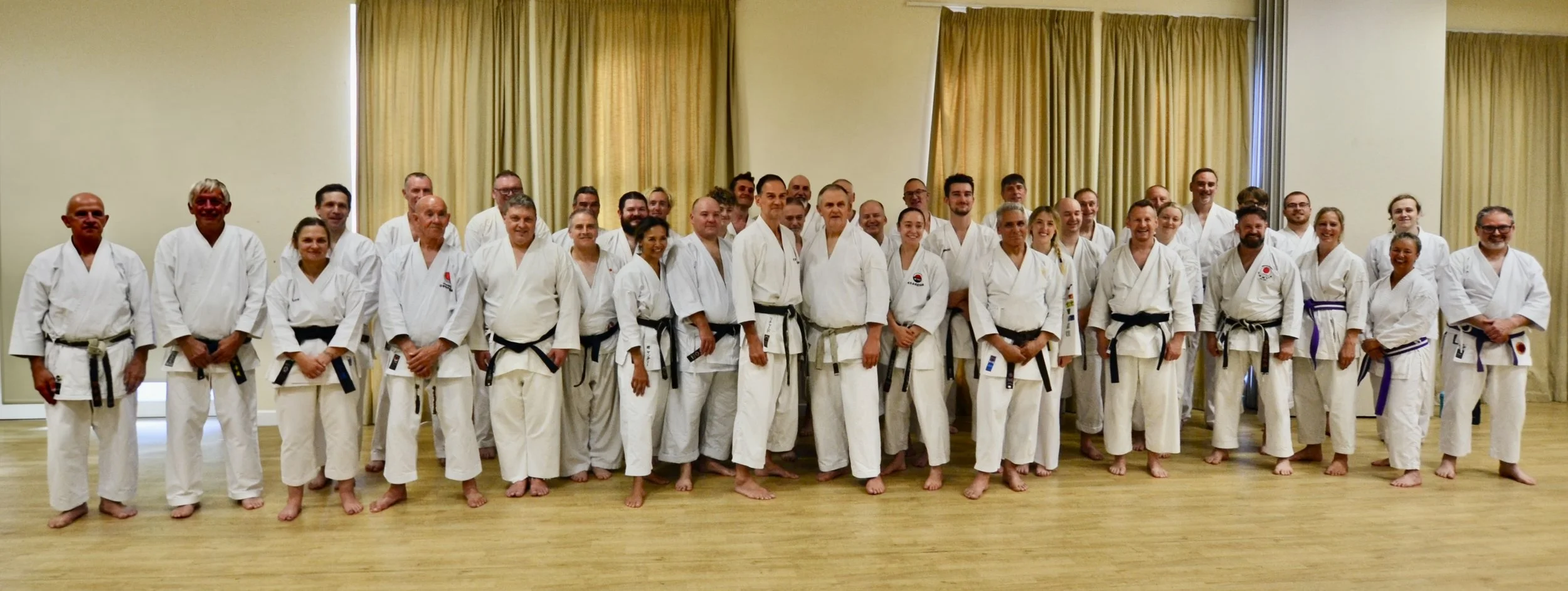
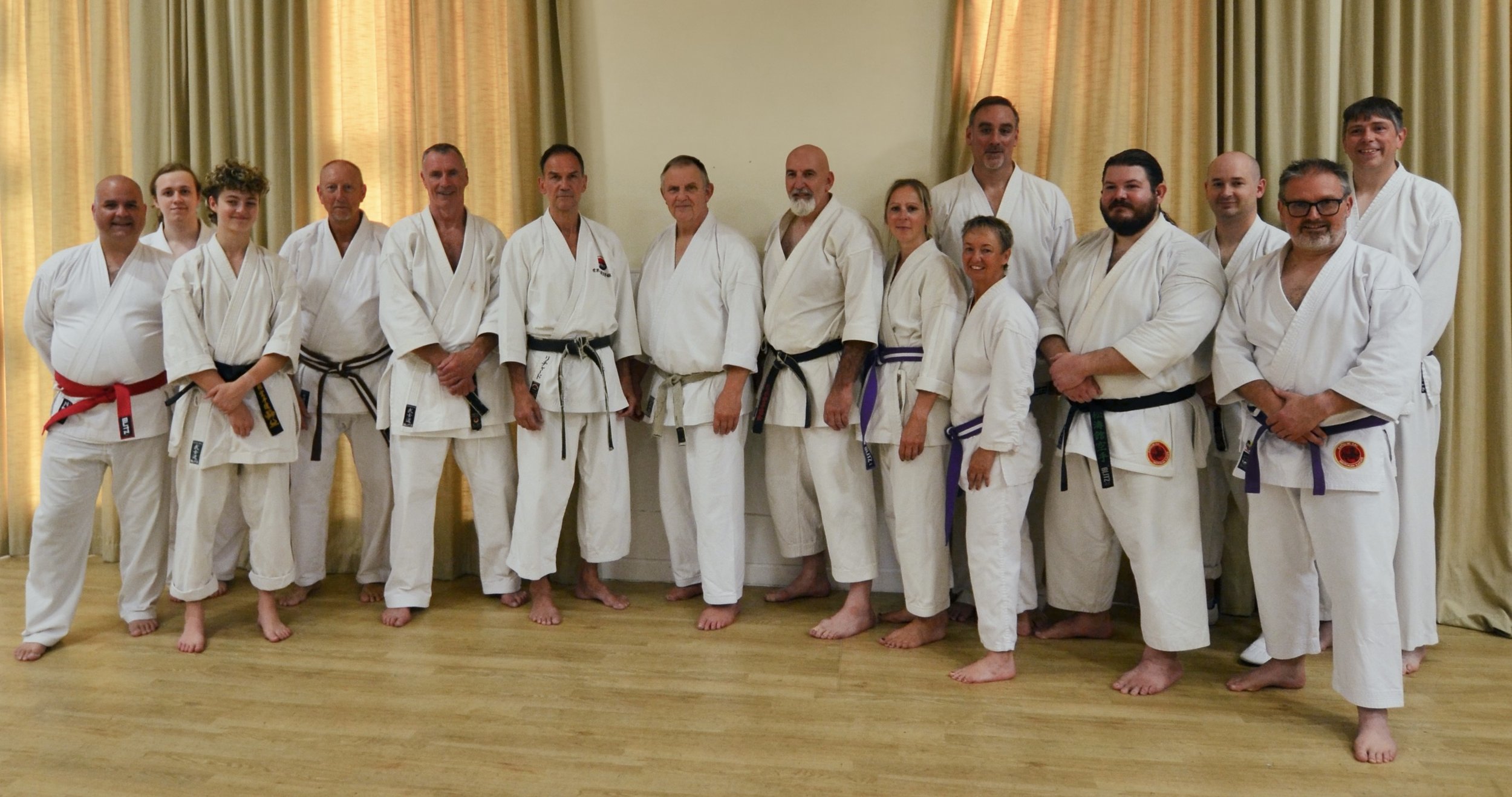
Below are some of our favourite photographs from the course, including everyone who joined us for a fantastic day of training.
Kata • Bunkai • Self-Defence • Realism
Thank you to everyone who made the day such a success. We look forward to training together again soon.
KATSU-MI KAI
To overcome your weaknesses.
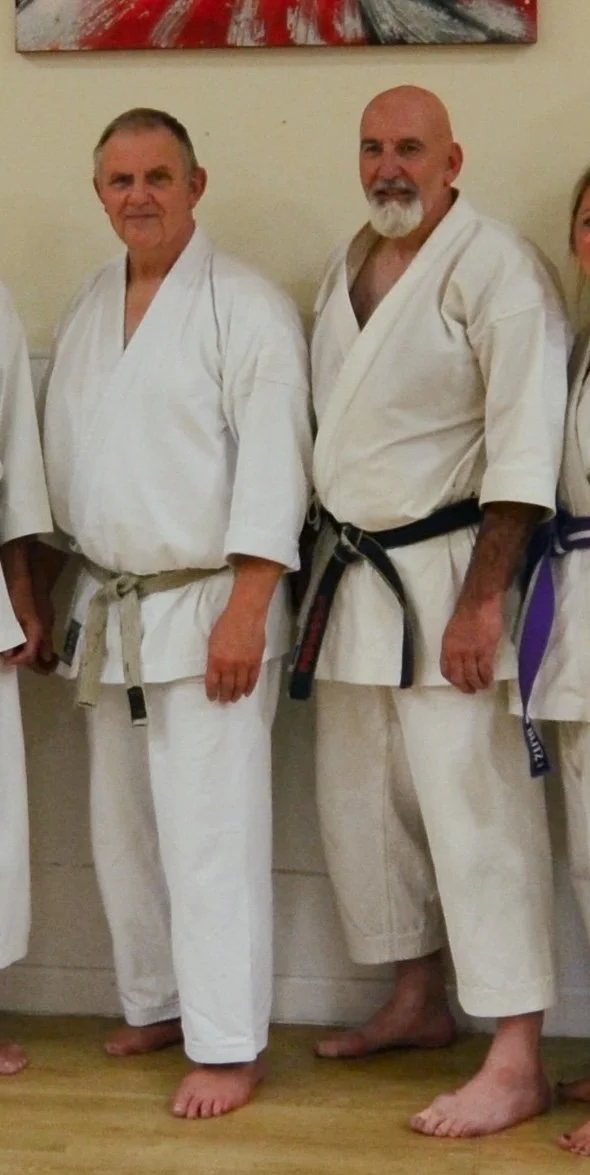
Jion: Temple Hand
A Kata and Bunkai Masterclass with Sensei Richard Amos and Sensei Mark Carroll
By Martyn Chapman
On 4 October, I had the pleasure of attending another of the collaborative training courses organised by Katsumi-Kai, featuring Sensei Richard Amos and Sensei Mark Carroll. Once again, participants were treated to a masterclass in movement, technique and practical bunkai, centred on the Shotokan kata Jion.
The Meaning and Spirit of Jion
The name Jion has several interpretations, many of which reflect the historical and cultural connections between traditional karate, China and Buddhism. Its opening posture, Jiai no Kamae, with the left hand positioned over the right, is also found in its sister kata, Jitte and Jiin. This connection is often associated with the expression “Temple Hand”.
These kata embody principles of discipline, concentration and strong fighting spirit. Traditionally, Jion is expected to express the composure and serenity associated with Buddha, combined with powerful, grounded technique and a practical understanding of application and bunkai.
Sensei Richard Amos: The Mechanics of Movement
Following introductions by Sensei Carroll, Sensei Amos opened the course by examining the initial sequence of movements in Jion.
Over many years of dedicated study and training in Shotokan, Sensei Amos has developed a remarkable understanding of the mechanics of movement. His ability to explain the principles of efficient, dynamic movement within even a small number of techniques was particularly impressive. These are details that can easily be overlooked or misunderstood, yet they are fundamental to understanding the true purpose of traditional kata.
Having been invited by Sensei Amos to assist with several demonstrations, I experienced first-hand the power and effectiveness of his technique. This power was not simply a product of strength or speed, but of an exceptional understanding of body mechanics, structure, timing and the efficient use of the body’s potential.
It was refreshing to see traditional techniques taught with such clarity and purpose, preserving the principles intended to be passed on to future generations.
In an era when karate can sometimes appear increasingly focused on speed, competitive performance and medals, it was a valuable reminder that the outward appearance of a technique should never take precedence over its underlying function. True understanding comes from appreciating both the form and the purpose behind it.
Sensei Mark Carroll: Bringing Kata to Life Through Bunkai
Following Sensei Amos’s session, Sensei Carroll took over, building on the movement principles already established and demonstrating how they translate into practical application.
The central theme of these courses is that the mechanics of traditional kata must be understood and retained when applying bunkai. The challenge is to move from the structured movements practised in the dojo to their effective application in a more realistic, freestyle context.
Sensei Carroll approaches bunkai through his understanding of habitual acts of violence, exploring how the movements contained within kata can be applied to practical self-defence scenarios. His approach demonstrates that even techniques which may initially appear abstract or unconventional have a clear relationship to the traditional movements of the kata.
Students paired up to practise the applications, gradually developing a better understanding of how the movements of Jion could be interpreted and applied. One of the most important learning points was recognising the transition between formal dojo technique and the less structured nature of practical application.
This transition can be challenging for many karateka. Performing a movement correctly within the familiar framework of kata is one thing; understanding how to adapt that same movement to a dynamic, unpredictable situation is another. Sensei Carroll’s teaching provided a clear and effective way of bridging that gap.
From Dojo Kata to “Street Kata”
One of the most effective teaching methods used by Sensei Carroll involved a demonstration designed to make the relationship between traditional kata, bunkai and practical application immediately visible.
Three demonstrations were presented side by side.
On the right, a student stood in the traditional yoi position, with the hands positioned left over right, ready to perform the kata in its formal dojo style.
I stood in the middle in a more natural, freestyle ready position, with my hands raised in what is commonly referred to as the fence—a position that can be adopted when seeking to manage a potentially threatening confrontation.
On the left, two students faced one another, ready to demonstrate the bunkai application.
At Sensei Carroll’s command, the two students on the left performed the bunkai for the opening five movements of Jion. The emphasis was on observing the movement of the student applying the techniques and recognising how the underlying principles of the kata were being used.
I then performed the same five movements as a solo sequence, adapting them to the freestyle context. This exercise, referred to as “Street Kata”, provided a visual representation of the application without the need for a training partner.
Finally, the student on the right performed the opening five movements of Jion in the traditional dojo style.
By comparing these three demonstrations, students could clearly see the relationship between the formal kata, its partnered application and the solo freestyle representation. The movements were not separate or unrelated interpretations; rather, each demonstrated a different expression of the same underlying principles.
The “Street Kata” approach proved to be a particularly useful training aid. It helped students visualise the transition from formal technique to practical application, reinforcing the connection between Sensei Amos’s emphasis on precise movement mechanics and Sensei Carroll’s approach to bunkai.
The demonstration also highlighted an important principle: effective bunkai should not be detached from the kata itself. Instead, it should emerge from a genuine understanding of the movements, their mechanics and their intended function.
Two Perspectives, One Shared Understanding
Once again, Sensei Richard Amos and Sensei Mark Carroll demonstrated how complementary their teaching approaches are.
Sensei Amos’s detailed analysis of movement provides the technical foundation: an understanding of body mechanics, structure, efficiency and power. Sensei Carroll then builds upon that foundation, showing how these principles can be applied through practical bunkai.
Together, they offer students a valuable opportunity to explore kata beyond its external form and develop a deeper appreciation of its purpose.
The course was an outstanding example of how traditional karate can be taught with both technical integrity and practical relevance. It reinforced the importance of preserving the fundamental principles of Shotokan while ensuring that kata remains a living practice, understood through both movement and application.
For everyone fortunate enough to attend, the session provided much more than an examination of Jion. It offered a deeper insight into the relationship between kata, bunkai and effective technique, leaving participants with plenty to reflect upon and apply in their own training.
My thanks go to Sensei Richard Amos, Sensei Mark Carroll and Katsumi-Kai for another excellent course. Their combined knowledge, experience and passion for karate made this a genuinely memorable training experience.
An outstanding masterclass in movement, application and the enduring value of traditional Shotokan karate.