
Sensei Jonathan Woods (3rd Dan)
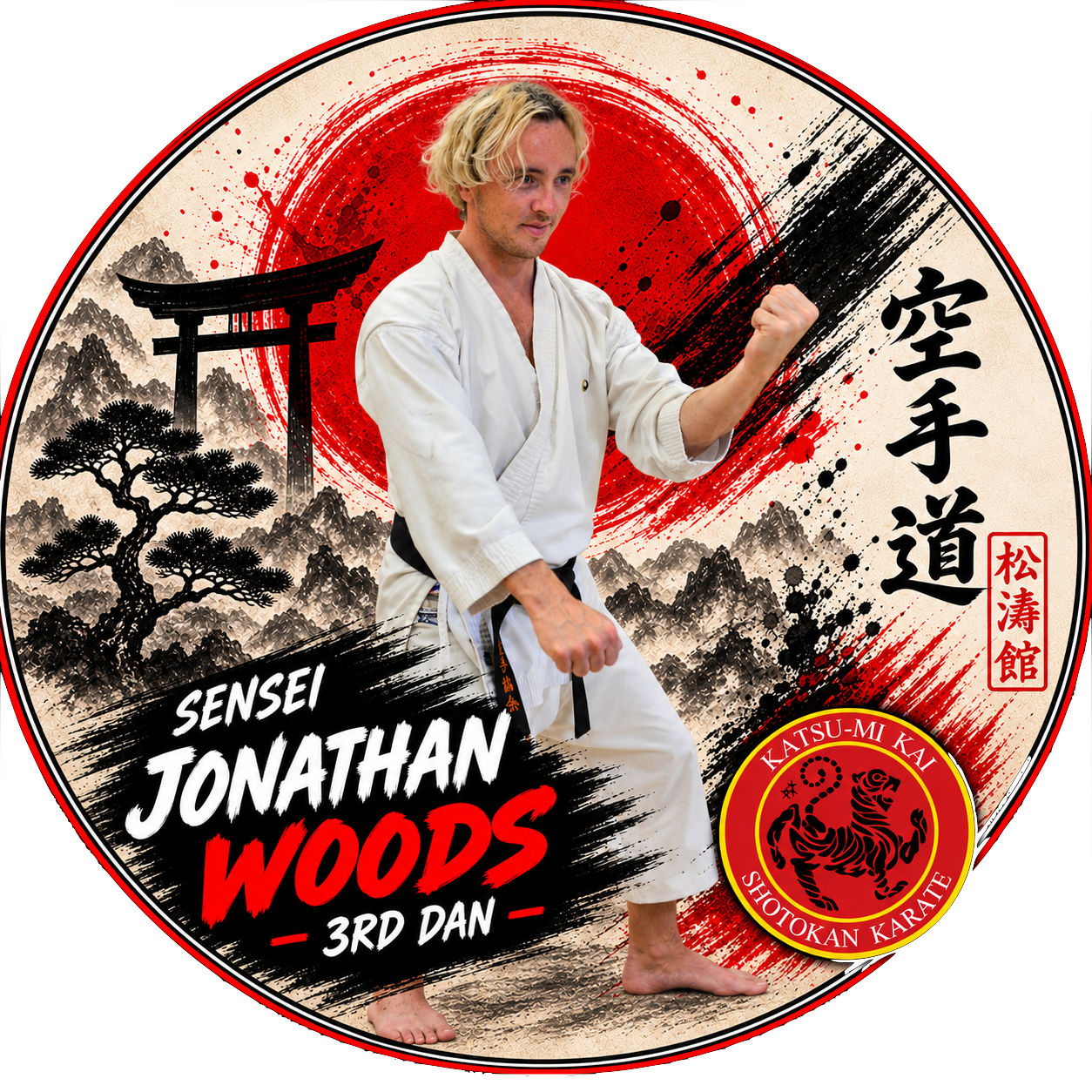
My Karate Journey
I began my karate journey in 2003, when I was around 11 years old. My introduction to karate was perhaps a little unusual, as I started training at the back of a pub, but from those early beginnings karate went on to become a long-term part of my life.
Over the years, I have trained with St Ives, FBSKU, JKA and now Katsu-Mi Kai, giving me the opportunity to experience different approaches to Shotokan karate and develop my own understanding along the way.
A major influence on my karate has been Sensei Steve Matteson. Steve combines an old-school, hard approach to karate with a willingness to continually question, learn and develop. Alongside Sensei Chris Tyler, this has helped bring together traditional karate with a more modern interpretation.
For me, that doesn't mean making karate more flashy or competition-focused. It's about stripping away unnecessary movement and rediscovering what the original Japanese instructors intended the techniques to achieve.
My approach was further influenced after attending a course with Sensei Mark Carroll, where the focus on kata, bunkai and practical self-defence reinforced my interest in understanding karate as something that needs to work in realistic and potentially dangerous situations.
My Approach to Teaching
My role within Katsu-Mi Kai is both student and teacher.
Progressing through karate isn't simply about collecting belts or reaching the next grade. Teaching gives me an opportunity to pass on the knowledge I have gained while continuing to learn and develop myself.
Even after many years of training, there is always something new to understand, refine or rediscover.
I also believe karate should give students something that extends beyond physical technique. The qualities developed through training can carry into everyday life and provide skills and values that remain useful regardless of someone's circumstances.
Kata, Bunkai & Practical Karate
My relationship with kata has changed considerably throughout my karate journey.
At one stage, kata could feel like a chore – a prescribed set of movements that had to be learned simply to progress through a grading.
Over time, however, my understanding changed.
Rather than seeing kata simply as a collection of blocks, kicks and punches, I began to understand the movements as containing practical fighting knowledge that has been passed down through generations.
That has led to a much greater appreciation of bunkai and practical application – looking beyond how a movement appears and asking what it could actually mean and how it could be used.
For me, this is where kata becomes much more interesting. Instead of simply reproducing a sequence of movements, we can begin to explore the purpose behind those movements and how the principles contained within them could apply in a real situation.
Favourite Kata – Jin
My favourite kata is Jin.
Like other aspects of my karate, my appreciation of kata has developed as my understanding of the practical applications behind the movements has grown.
Still Learning
One of the most important things karate has taught me is that it is a lifelong journey.
You don't walk into a dojo and suddenly become invincible. Progress comes from continued training, questioning, learning and developing.
Reaching a Dan grade doesn't mean that journey is finished either. There is always another detail to discover, another technique to refine and another opportunity to improve.
That applies whether I'm standing in the dojo as a student or helping someone else with their own karate.